


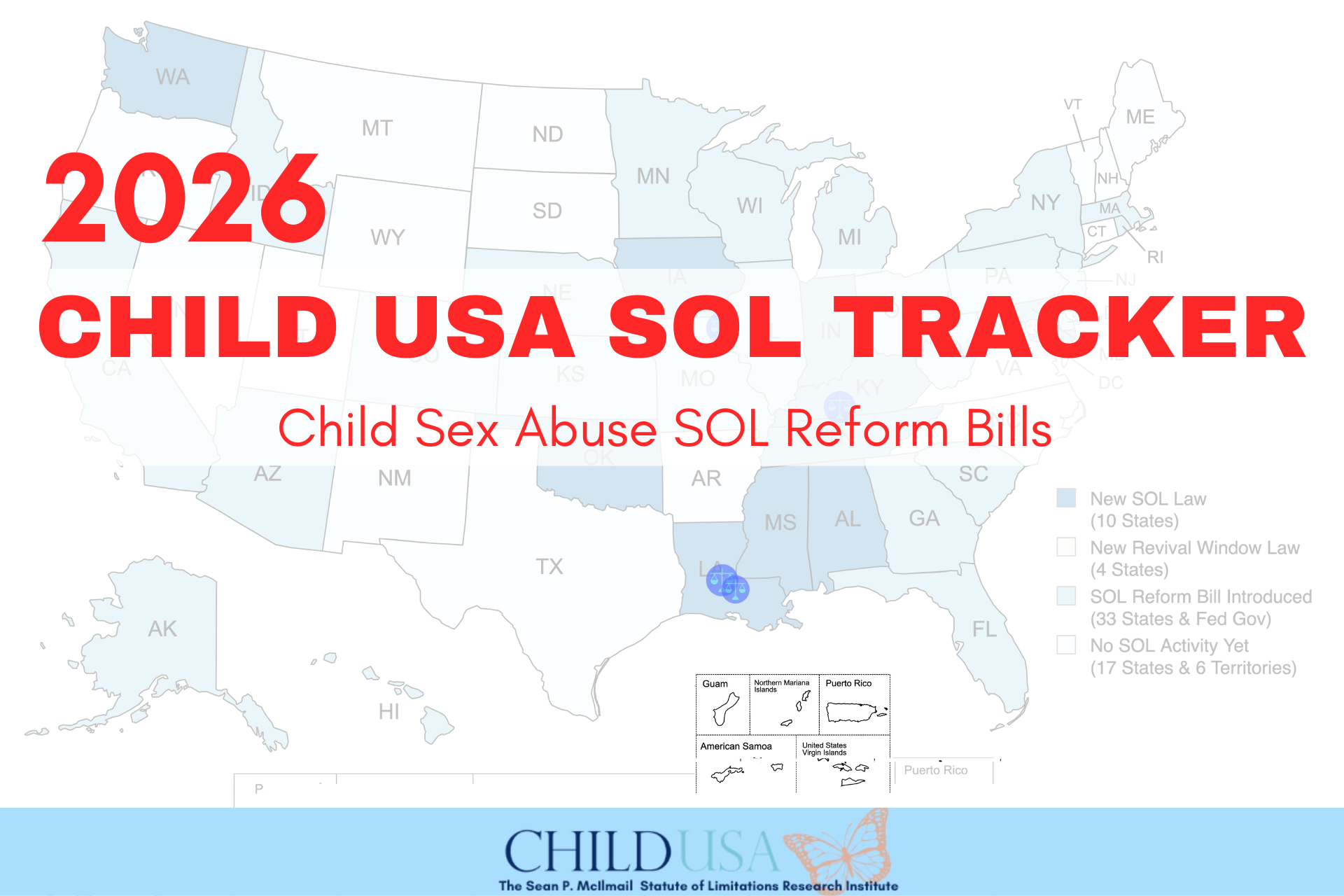
2026 SOL TRACKER

Statute of limitation (SOL) reform is the key to attaining justice for survivors and preventing future abuse
CHILD USA leads the national SOL reform movement to change SOLs to prevent child sex abuse and empower victims. CHILD USA partners with lawmakers, advocates, and victims across the United States to change SOLs to reflect the science of delayed disclosure and serve the public interest. Our goal is to eliminate civil and criminal SOLs for child sex abuse crimes, and revive civil claims that were unfairly blocked by short SOLs.
2026 SOL REFORM BILLS
NEW SOL REFORM LAWS OR RESOLUTIONS GOING INTO EFFECT
| State | SOL Reform Law | |
| Arkansas | Opens a 1-year revival window for child sexual abuse claims against an entity that has been provided protection under a plan of reorganization initiated by a congressionally chartered organization on February 18, 2020 (Boy Scouts of America bankruptcy). (S.B. 13 (Act 49)) (Enacted 2025; effective date not confirmed in tracker) | |
| Eliminates the criminal SOL for certain human trafficking-related offenses, including sexual extortion involving minors, trafficking of persons, patronizing a victim of human trafficking, and grooming a minor. Also creates safe harbors for victims and prohibits certain sexually explicit products that resemble a child. (S.B. 431 (Act 987)) (Effective April 23, 2025) | ||
| California | Extends the period for reviving sexual assault claims barred by the SOL through January 1, 2026, and allows civil filings until December 31, 2027, while exempting public entities and requiring allegations of cover-ups by responsible entities. (A.B. 250) (Effective Jan. 1, 2026) | |
| Illinois | Eliminates the criminal SOL for trafficking offenses against minors (involuntary servitude, involuntary sexual servitude of a minor, and trafficking in persons), allowing prosecution at any time for offenses occurring on or after the effective date. (H.B. 2602 (Public Act 104-0241)) (Effective Jan. 1, 2026) | |
| Renames “child pornography” to “child sexual abuse material” throughout Illinois law and extends the criminal SOL for grooming, allowing prosecution within 10 years after the victim attains 17 years of age. (H.B. 2690 (Public Act 104-0245)) (Effective Jan. 1, 2026) | ||
| Maryland | Allows child sexual abuse claims to be filed at any time but prohibits such claims against the State after January 1, 2026, and caps noneconomic damages. CHILD USA opposes the State liability restriction and damages cap, which roll back protections from the 2023 Maryland Child Victim’s Act. (H.B. 1378 (Chapter 104)) (Effective June 1, 2025) | |
| Missouri |
H.B.737/486 + S.B.43 + S.B.81/174 – These three bill numbers merged into a single amendment to the civil childhood sexual abuse statute (§537.046). It revises the definition of “childhood sexual abuse” for civil damages claims, makes nondisclosure agreements in CSA cases void and unenforceable, and applies to actions on or after August 28, 2025, including some that were previously time-barred. Important: the separate SOL age-cap extension (S.B.589) did NOT pass, so please don’t describe this as Missouri extending its SOL.
Status/effective: Enacted; effective August 28, 2025.
Sources: revisor.mo.gov/main/OneSection.aspx?section=537.046 | mocadsv.org/legislative_updates/2025-end-of-session-report/
|
|
| Oklahoma | Extends the criminal SOL for sexual crimes against children, including rape and lewd acts, to age 45. Prosecution may be commenced at any time with DNA evidence. (H.B. 1935) (Effective Nov. 1, 2025) | |
| Oregon | Eliminates the civil SOL for both child sexual abuse and adult sexual assault, allowing claims to be filed at any time for incidents occurring on or after the effective date. (H.B. 3582) (Effective June 26, 2025) | |
| Tennessee | Extends the civil SOL for child sexual abuse from 15 to 30 years from the victim’s 18th birthday. Also extends from 25 to 30 years the threshold beyond which prosecutors must offer corroborative evidence for late criminal prosecutions. (H.B. 0973 (Public Chapter 291)) (Effective July 1, 2025) | |
| Texas | Eliminates the criminal SOL for failure to stop or report sexual or assaultive offenses against a child, and creates the crime of continuous promotion of prostitution with no SOL. (H.B. 1778) (Effective Sept. 1, 2025) | |
| Limits the civil liability of nonprofit entities contracted with the Department of Family and Protective Services or with a single source continuum contractor providing community-based care or child welfare services. CHILD USA opposes. (S.B. 1558) (Effective Sept. 1, 2025) | ||
| Adds continuous sexual abuse of a young child and indecency with a child to the criminal no-limitation list. Also extends the criminal SOL for fraud offenses to 7 years and clarifies that the 20-year-from-18-birthday SOL applies to trafficking of a child. (S.B. 2798) (Effective Sept. 1, 2025) | ||
| Total | Eight States with New SOL Reform Laws in 2025 | |
| 2026 New SOL Reform Laws | ||
| Idaho |
H.681 Expands the list of felonies with no criminal statute of limitations to add aggravated lewd conduct with a minor under 16 (§18-1508B), aggravated lewd conduct with a minor 12 or under (§18-1508C), and the production of child sexual abuse material (§18-1507(2)(b)). Note: this does NOT create the no-SOL rule for child sexual abuse — Idaho already eliminated that; H.681 expands the list.
Status/effective: Enacted; Session Law Chapter 191; effective July 1, 2026.
Sources: legislature.idaho.gov/wp-content/uploads/sessioninfo/2026/legislation/H0681.pdf | legiscan.com/ID/bill/H0681/2026
|
|
| Utah |
S.B.30 (Human Trafficking, Exploitation, and Smuggling Amendments) Adds the newly created child sex-trafficking offense (human trafficking of a child for commercial sexual exploitation, §76-5-308.6) and aggravated human trafficking for commercial sexual exploitation (§76-5-310.2) to the list of crimes prosecutable at any time (no criminal SOL, §76-1-301). No offense loses no-SOL status.
Status/effective: Enacted; signed March 23, 2026; effective May 6, 2026.
Sources: le.utah.gov/Session/2026/bills/enrolled/SB0030.pdf (Section 7) | le.utah.gov/Session/2026/bills/static/SB0030.html
|
|
|
H.B.139 (Female Genital Mutilation Amendments) Eliminates the criminal statute of limitations for female genital mutilation by adding the offense (§76-5-702) to the no-criminal-SOL list (§76-1-301); also repeals the FGM community-education-program requirement.
Status/effective: Enacted; effective May 6, 2026.
Sources: le.utah.gov/Session/2026/bills/enrolled/HB0139.pdf | trackbill.com/bill/utah-house-bill-139-female-genital-mutilation-amendments/2762605/
|
|
|
| Total |
Three States with New SOL Reform Laws in 2026
|
|
SOL REFORM BILLS PASSED IN LEGISLATURE
| State | Bill | Description | Bill Link |
| California | S.B.577 | State Government. (CHILD USA opposes) | View Bill |
| Delaware | H.B. 75 | An Act To Amend Title 10 Of The Delaware Code Relating To The Statute Of Limitations For Civil Claims Based On Sexual Abuse Of A Minor. | View Bill |
| Maine | ME L.D. 1427 (H.P. 936) (Effective July 14) | An Act Extending the Statute of Limitations on Criminal Actions Involving Aggravated Sex Trafficking. 20 year SOL for aggravate sex trafficking. | View Bill |
| Michigan | S.B.0258 | Civil procedure: statute of limitations; civil actions for criminal sexual conduct; modify period of limitations. Amends sec. 5805 of 1961 PA 236 (MCL 600.5805). TIE BAR WITH: SB 259’25, SB 257’25 | View Bill |
| Missouri | H.B. 68 | Modifies the statute of limitations for personal injury claims from five years to two years | View Bill |
| New Jersey | A.5004 | Creates separate crime for items depicting sexual exploitation or abuse of children; concerns computer generated or manipulated sexually explicit images. | View Bill |
| New Mexico | H.B. 73 | Childhood Sexual Abuse Statute Of Limitations | View Bill |
| New York | S.116 | Relates to the statute of limitations of actions related to certain sex trafficking offenses | View Bill |
| Texas | H.B. 380 | Relating to certain statutes of limitations for criminal offenses, including the statute of limitations for the offense of improper relationship between educator and student, and to the applicability of sex offender registration requirements for the offense of improper relationship between educator and student. | View Bill |
| Utah | H.B.117 | Sexual Abuse Statutes of Limitation Amendments | View Bill |
| Washington | S.B. 5105 | SB 5105 (Effective June 11, 2026) updates the state’s child protection laws to cover AI-generated and digitally fabricated sexual images of minors, even when no real child exists, and strengthens penalties accordingly. Effective June 11, 2026, it also extends the statute of limitations for these crimes to ten years, closing critical gaps in the digital age. | View Bill |
SOL REFORM BILLS INTRODUCED IN LEGISLATURE
| State | Bill | Description | Bill Link |
| Hawaii | H.B.384 | RELATING TO SEXUAL OFFENSES AGAINST MINORS. | View Bill |
| Illinois | HB1114 | Limitations-Victim Under 18 | View Bill |
| Indiana | S.B.0143 (2026) |
Would eliminate the criminal SOL for Level 3 felony rape (IC 35-42-4-1) and Level 3 felony child molesting (IC 35-42-4-3) — making them prosecutable at any time — and adds a clause reviving previously time-barred cases. Amends IC 35-41-4-2.
Status: Introduced; pending in Senate Corrections & Criminal Law Committee.
|
View Bill |
| S.B.0196 (2025) |
The prior-session predecessor of S.B.0143 — same IC 35-41-4-2 amendment (no criminal SOL for Level 3 rape and child molesting). Died in committee in the 2025 session. List as the 2025 version of the same reform.
|
View Bill | |
| Iowa | H.F.908 | A bill for an act relating to human trafficking, including screening children, civil statutes of limitations, an annual stakeholder meeting and report, depositions of victims, restitution, restorative facilities and protective services, and investigation and prosecution, and making appropriations.(Formerly HF 452; See HF 1036.) | View Bill |
| S.F.364 | A bill for an act modifying the periods of time to bring certain civil actions by victims of sexual abuse and other sexual offenses that occurred when the victim was a minor, entitling certain cases to a preference in trial order, and including effective date provisions. | View Bill | |
| S.F.67 | A bill for an act modifying the periods of time to bring certain civil actions, including by victims of sexual abuse, minors, and persons with mental illness, entitling certain cases to a preference in trial order, and including effective date provisions. | View Bill | |
| Kentucky | H.B.232 | AN ACT relating to childhood sexual assault or abuse. | View Bill |
| Massachusetts |
H1732 | An Act amending the statute of limitations relating to civil rights actions and criminal prosecutions for the sexual assault and rape of a child | View Bill |
| H1829 | An Act eliminating the statute of limitation in civil child sexual abuse cases | View Bill | |
| S404 | An Act relative to supporting survivors of child sexual abuse | View Bill | |
| MA H5630 (Introduced July 30) | An Act strengthening primary care and advancing health care affordability. | View Bill | |
| Mississippi | S.B. 2318 | Child sexual abuse; revise statute of limitations for claims. | View Bill |
| Missouri | H.J.R. 58 | Proposes a constitutional amendment allowing ex post facto laws to be enacted if the laws involve civil child sexual abuse claims | View Bill |
| S.B. 589 | Modifies provisions relating to civil actions for childhood sexual abuse, including the statute of limitations for such actions | View Bill | |
| S.B. 747 | Modifies provisions relating to civil actions for childhood sexual abuse, including the statute of limitations for such actions | View Bill | |
| New York | A.1641 | Removes statute of limitations for certain civil actions related to child sexual assault offenses | View Bill |
| A.2575 | Relates to the statute of limitations of actions related to certain sex trafficking offenses | View Bill | |
| A.7003A | Expands the statute of limitations for certain sex offenses | View Bill | |
| A.7258 | Enacts the Child Sexual Abuse Reform Act; provides for the elimination and extension of certain statutes of limitations relating thereto | View Bill | |
| S.6978 | Removes statute of limitations for certain civil actions related to child sexual assault offenses | View Bill | |
| Oregon | H.B.3581 | Removes the statute of limitations for most felony sex crimes. | View Bill |
| Rhode Island | H.B.6133 | An Act Relating To Criminal Procedure — Indictments, Informations And Complaints (Provides That The Statute Of Limitations For Second-Degree Sexual Assault Shall Be 10 Years From The Date Of The Offense, Or, In The Case Of A Victim Who Is Under The Age Of 18, Ten Years From The Victim’S Eighteenth Birthday, Whichever Is Later.) | View Bill |
| S.B.739 | An Act Relating To Courts And Civil Procedure–Procedure Generally — Causes Of Action (Makes All Causes Of Action Based On Sexual Abuse Or Exploitation Of A Child Not Subject To Any Statute Of Limitations Whether The Claim Has Lapsed Or Was Previously Time-Barred.) | View Bill | |
| South Carolina | S.B.0148 | Sexual Abuse and Incest | View Bill |
| Tennessee | SB1070 | Statutes of Limitations and Repose – As enacted, extends the statute of limitations for criminal prosecution of certain child sexual abuse felonies from 25 years from the child’s eighteenth birthday to 30 years from the child’s eighteenth birthday; extends the statute of limitations for a civil action based on child sexual abuse from 15 years from the child’s eighteenth birthday to 30 years from the child’s eighteenth birthday. – Amends TCA Title 28 and Title 40, Chapter 2. Companion bill has been assigned Public Chapter 291 by the Secretary of State. Conference Committee Reports | View Bill |
| SB1234 | Civil Procedure – As introduced, revives causes of action based on a sexual assault that occurred when the injured party was 18 years of age or older and are time-barred because the applicable statute of limitations has expired; allows such actions to be commenced within a certain time period. – Amends TCA Title 28, Chapter 3; Title 39 and Title 40. Conference Committee Reports | View Bill | |
| Texas | H.B. 2022 | Relating to elimination of limitations periods for suits for personal injury arising from certain offenses against a child or disabled individual. | View Bill |
| H.B. 3453 | Relating to the liability of nonprofit entities contracted with the Department of Family and Protective Services or with a single source continuum contractor to provide community-based care or child welfare services. (CHILD USA opposes) | View Bill | |
| H.B. 4724 | Relating to the civil liability of nonprofit entities. (CHILD USA opposes) | View Bill | |
| H.J.R. 120 | Proposing a constitutional amendment protecting children by allowing for retroactive laws regarding civil causes of action arising out of child sexual abuse. | View Bill | |
| S.B. 1167 | Relating to elimination of limitations periods for suits for personal injury arising from certain offenses against a child or disabled individual. | View Bill | |
| S.J.R. 51 | Proposing a constitutional amendment protecting children by allowing for retroactive laws regarding civil causes of action arising out of child sexual abuse. | View Bill |
At a Glance:
CHILD USA SOL RANKINGS
SUMMARY OF CRIMINAL SOL ELIMINATION LAWS IN 44 STATES, FEDERAL GOVERNMENT AND D.C.
| Alabama | None for victims abused when they were under 16 |
| Alaska | None for victims abused when they were under 18 (felony charge) |
| Arizona | None for victims abused when they were under 15 or under 18 if the abuser is a parent, guardian, teacher or priest, or for child sex trafficking |
| Arkansas | None (as of 2013) |
| California | None for felony sex offenses |
| Colorado | None for felony child sexual offenses |
| Connecticut | None for class A felonies and for any offense involving sexual abuse, sexual exploitation or sexual assault of a minor, including risk of injury involving intimate contact with a victim under age 16. |
| Delaware | None |
| Florida | None for felony sexual battery of minors (defined by Fla. Stat. § 794.011) an adult using or promoting a child in a sexual performance. |
| Georgia | None for (1) trafficking a person for sexual servitude; (2) cruelty to children in the first degree; (3) rape; (4) aggravated sodomy; (5) child molestation or aggravated child molestation; (6) enticing a child for indecent purposes; or (7) incest. |
| Hawaii | None for 1st and 2nd degree sexual assault, continuous sexual assault of a minor under 14, and sex trafficking |
| Idaho | Elimination for felony sex abuse and lewd conduct with a child. |
| Illinois | None for felonies and misdemeanors |
| Indiana | None if offense committed with threats or use of deadly force (class A) |
| Iowa | None for all child sex abuse felonies and misdemeanors. |
| Kansas | None for rape, CSA, trafficking, and CSAM |
| Kentucky | None for felonies |
| Louisiana | None for prosecutions of crimes for that are punishable by death or life imprisonment, including aggravated rape and forcible rape |
| Maine | None for victim under 16 for felony and misdemeanor incest; unlawful sexual contact; sexual abuse of a minor; rape or gross sexual assault, formerly denominated as gross sexual misconduct. None for sexual assault and sexual exploitation of minors. |
| Maryland | None for felonies and misdemeanor revenge porn |
| Massachusetts | None where victim under 16 (after +27 years DNA or other corroborating evidence needed) |
| Michigan | None 1st degree crimes. |
| Minnesota | None for the following felonies: solicitation, inducement, and promotion of prostitution, sex trafficking, and criminal sexual conduct in the 1st, 2nd, 3rd, and 4th degrees. |
| Mississippi | None if (1) victim was abused during ages 14-16 and offender is 3 years older; (2) victim was abused under 14 and offender 2 years older; (3) victim was abused under 18 and abuser is in a position of authority or trust; or (4) involving touching or handling of children for lustful purposes |
| Missouri | Murder, forcible rape, attempted forcible rape, forcible sodomy, attempted forcible sodomy, or any class A felony |
| Montana | None |
| Nebraska | None for felony 1st or 2nd degree sexual assault, or misdemeanor 3rd degree sexual assault when victim was abused under the age of 16, felony incest, sex trafficking of a minor and child pornography. |
| New Jersey | None for sexual assault or aggravated sexual assault |
| New Mexico | None for 1st degree felonies |
| New York | None for 1st degree felonies |
| North Carolina | None |
| Pennsylvania | None for felony trafficking, sexual servitude, rape, statutory sexual assault, involuntary deviate sexual intercourse, sexual assault, institutional sexual assault, aggravated indecent assault and incest. |
| Rhode Island | None for 1st degree sexual assault, and 1st and 2nd degree child molestation |
| South Carolina | None |
| South Dakota | None for class A, B, and C felonies; all child rape & forcible rape |
| Tennessee | None for child sex abuse felonies and misdemeanors |
| Texas | None for most sex crimes against young children |
| Utah | None for rape of a child, object rape of a child, sodomy on a child, sexual abuse of a child, aggravated sexual abuse of a child, human trafficking of a child |
| Vermont | None for aggravated sexual assault and sexual exploitation of a minor |
| Virginia | None for felonies |
| Washington | None for felony rape, sexual misconduct, child molestation, sexual exploitation of a minor, and trafficking |
| West Virginia | None for sexual assault, 1st degree sexual abuse, sexual abuse by parent, guardian, custodian, or person in a position of trust to child |
| Wisconsin | None for 1st degree sexual assault, or repeated class A or B felony offenses against the same child |
| Wyoming | None |
| Washington D.C. | None for felony sexual abuse, child sexual abuse, sexual abuse of a minor, and incest. |
| Federal Government | None |
| Total | Forty-four (44) States, Federal Government and Washington D.C. Eliminated Criminal SOLs |
SUMMARY OF CIVIL SOL ELIMINATION LAWS IN 19 STATES, FEDERAL GOVERNMENT AND 2 TERRITORIES
| Alaska | None for felony sex abuse of a minor and felony sexual assault (as of 2001), unlawful exploitation of a minor (as of 2003), and felony sex trafficking or felony human trafficking (as of 2013). Applies to claims against perpetrators arising after the effective dates and to non-expired claims arising before. (Alaska Stat. Ann. § 09.10.065). |
| Arizona | None for action based on sex trafficking of minors and adults (as of 2021). (AZ ST § 12-721). |
| Arkansas | None for sexual abuse of minors and adults with disabilities (as of 2023). (AR ST § 16-118-118; SB 204). |
| California | None for CSA claims arising on and after January 1, 2024. (CA CIV PRO § 340.1; AB 452). |
| Colorado | None for sexual assault of minors and adults. Applies to claims against all defendants arising after the effective date and to non-expired claims arising before (as of 2021). (SB21-073, 73rd General Assembly, 1st Reg. Sess. (2021)). Also, none for new cause of action for sexual misconduct with minors. Applies to claims against perpetrators, private institutions, and government for abuse in 2022 or later (as of 2022). (SB21-088, 73rd General Assembly, 1st Reg. Sess. (2021)). |
| Connecticut | None if events forming the civil claim led to conviction of first-degree aggravated sexual assault or sexual assault. Applies to any cause of action arising from an incident committed prior to, on or after May 23, 2002. (Conn. Gen. Stat. § 52-577e). |
| Delaware | None for action based on sexual abuse of a minor by an adult. Effective as of July 10, 2007 and also applies to non-expired claims arising before that date. (Del. Code tit. 10, § 8145). |
| Florida | None for sexual battery offenses committed against victims under age 16. Effective as of July 1, 2010 and also applies to non-expired claims arising before that date. (Fla. Stat. Ann. § 95.11). None for trafficking of victims under age 16 for claims against adult theaters (as of 2023). (Fla. Stat. Ann. § 95.11). |
| Guam | None for action based on child sexual abuse. Effective as of September 23, 2016 and it is fully retroactive, applying to call claims arising before on or after that date. (GU ST T. 7, § 11301.1). |
| Illinois | None for action based on childhood sexual abuse. Effective as of January 1, 2014 and also applies to non-expired claims arising before that date. (IL ST CH 735 § 5/13-202.2). |
| Louisiana | None for actions based on sexual abuse of a minor. Effective June 14, 2021 and applies to non-expired claims arising before that date. (2021 La. Sess. Law Serv. Act 322 (H.B. 492)). |
| Maine | None for action based on sexual contact or sexual act with a minor. Effective as of April 7, 2000 and also applies to non-expired claims arising before that date. (ME ST T. 14 § 752-C). |
| Maryland | None for sexual abuse of a minor. Effective as of October 1, 2023 and it is fully retroactive, applying to call claims arising before on or after that date. (MD CTS & JUD PRO § 5-117; HB 1 & SB 686). |
| Minnesota | None for action based on sexual abuse of a minor. Effective as of May 25, 2013 and also applies to non-expired claims arising before that date. (Minn. Stat. § 541.073(b)). |
| Nebraska | None for action based on sexual assault of a child against a perpetrator. Effective as of August 24, 2017 and also applies to non-expired claims arising before that date. (Neb. Rev. St. § 25-228). |
| Nevada | None for action based on child sex abuse against a perpetrator where there is clear and convincing evidence of the abuse. (Petersen v. Bruen, 106 Nev. 271, 281 (1990)). None for claims against a perpetrator or someone criminally liable for sexual abuse or exploitation of a minor (including trafficking, prostitution, and pornography) and a promoter, possessor, or viewer of CSAM (child sexual abuse material). Effective as of June 2, 2021, and it is fully retroactive, applying to all claims arising before on or after that date. (2021 Nevada Laws Ch. 288 (S.B. 203)). |
| New Hampshire | None for action based on sexual assault or related offenses against minors and adults. Effective as of September 18, 2020. (NH ST § 508:4-g). |
| Northern Mariana Islands | None for action based on child sexual abuse. Effective as of November 10, 2021, and it is fully retroactive, applying to call claims arising before on or after that date. (2021 N.M.I. Pub. L. No. 22-12; HB 22-2, SDI). |
| Utah | None for action based on intentional or negligent sexual abuse of a minor against a perpetrator. Effective as of March 23, 2015. (Utah Code § 78B-2-308). |
| Vermont | None for action based on childhood sexual abuse. Effective as of July 1, 2019 and it is fully retroactive, applying to all claims arising before or on or after that date. (VT. STAT. ANN TIT. 12, § 522). |
| Washington | None for childhood sexual abuse occuring on or after June 6, 2024. Effective as of June 6, 2024. (WA ST 4.16.340; HB 1618). |
| Federal Government | None for offenses against minors, including child sex abuse, sex trafficking, exploitation, and CSAM. Effective September 16, 2022 and also applies to non-expired claims arising before that date. (S 3103 Eliminating Limits to Justice for Child Sex Abuse Victims Act of 2022). |
| Total | Nineteen (19) States, Federal Government, and Two (2) Territories Eliminated Civil SOLs |
SUMMARY OF CIVIL REVIVAL LAWS IN 30 STATES AND 3 TERRITORIES
| Alabama | (2024) Revives claims against a federally chartered organization initiating bankruptcy protection on February 18 2020, i.e. the Boy Scouts of America – open. (SB 18). |
| Arizona | (2019-20) 19-month window opened on May 27, 2019 for expired claims against perpetrators, private organizations and government and closed on December 31, 2020 – closed. Also revived SOL up to age 30. (AZ ST § 12-514; H.B. 2466, 54th Leg., 1st Reg. Sess. (Ariz. 2019)). |
| Arkansas |
(2022-23) 2-year window opened February 1, 2022 for expired claims against perpetrators, private organizations and government – closed early on July 31, 2023. (ARK. CODE ANN. § 16-118-118). (2024-26) 2-year window opens on February 1, 2024 for expired claims against perpetrators, private organizations and government – open. (SB 204). |
| California |
(2003-04) 1-year window revived SOL against private organizations only – closed. (Cal. Civ. Proc. Code § 340.1). (2005) 1-year window for expired claims against perpetrators who were being criminally prosecuted under California Penal Code § 803(g)’s criminal SOL revival provision, but whose criminal case was overturned as a result of U.S. Supreme Court ruling in Stogner – closed. (Cal. Civ. Proc. Code § 340.1). (2020-22) 3-year revival window opened on January 1, 2020 for expired claims against perpetrators, private organizations and government – open. Also revives SOL up to age 40. (Cal. Civ. Proc. Code § 340.1). |
| Colorado* | (2022-25) 3-year window opened on January 1, 2022 for claims of abuse occurring from 1960-2021 against perpetrators, private organizations and government, subject to damages caps – closed. Colorado’s new cause of action is not a revival law, but it is included in this section because it opens a window to justice for many survivors whose common law claims have expired. In 2023, the window was held unconstitutional. (SB21-088, 73rd General Assembly, 1st Reg. Sess. (2021)). |
| Connecticut | (2002) Revives SOL up to age 48 against perpetrators, private organizations and government. (Conn. Gen. Stat. § 52-577d). |
| Delaware |
(2007-09) 2-year window revived SOL against perpetrators, private organizations and government – closed. (Del. Code tit. 10, § 8145). (2010-12) Added 2-year window for healthcare providers because original window did not apply to claims against them – closed. (Del. Code tit. 18, § 6856). |
| Georgia | (2015-17) 2-year window revived SOL against perpetrators only – closed. (Ga. Code § 9-3-33.1). |
| Guam |
(2011) 2-year window revived SOL against their abusers – closed. (7 G.C.A. § 11306(2)). (2016) Permanently revives all expired claims against perpetrators, private organizations and government – open. (tit. 7 G.C.A. § 11301.1(b)). |
| Hawaii |
(2012-14) 2-year window revived SOL against perpetrators and private organizations – closed. (Haw. Rev. Stat. § 657-1.8). (2014-16) Extended original window for another 2 years and expanded to include claims against the government – closed. (Haw. Rev. Stat. § 657-1.8). (2018-20) Extended window was open until April 24, 2020 – closed. (Haw. Rev. Stat. § 657-1.8). |
| Indiana | (2024) Revives claims against a federally chartered organization initiating bankruptcy protection on February 18 2020, i.e. the Boy Scouts of America – open. (HB 1047) |
| Iowa | (2024) Revives claims against a federally chartered organization initiating bankruptcy protection on February 18 2020, i.e. the Boy Scouts of America – open. (SF 2431) |
| Kansas | (2023) Revives SOL up to age 31 or 3 years after criminal conviction. (S. Sub for HB 2127). |
| Kentucky | (2021) Revives SOL up to 5 years after the date the SOL expired. The revival law is not in effect because it was held unconstitutional in 2024. (2021 Kentucky Laws Ch. 89 (HB 472)). |
| Louisiana | (2021) 3-year window revives SOL against any party – open. (2021 La. Sess. Law Serv. Act 322 (H.B. 492)). |
| Maine | (2021) Permanently revives all expired claims against any party – open. (ME ST T. 14 § 752-C). |
| Maryland | (2023) Permanently revives all expired claims against any party – open. (HB 1 & SB 686). |
| Massachusetts | (2014) Revives SOL up to age 53 against perpetrators only. (Mass. Gen. Laws ch. 260, § 4C; 2014 Mass. Legis. Serv. Ch. 145 (H.B. 4126)). |
| Michigan | (2018) 90-day window revived SOL for victims of Larry Nassar only – closed. (Mich. Comp. Laws § 600.5851b). |
| Minnesota | (2013-16) 3-year window revived SOL against perpetrators and private organizations – closed. (Minn. Stat. § 541.073, 2013 Minn. Sess. Law Serv. Ch. 89 (H.F. 681)). |
| Montana | (2019-20) 1-year window opened on May 7, 2019 for expired claims against perpetrators and entities – closed. Also revives SOL up to age 27. (Mont. Code § 27-2-216). |
| Nevada | (2021) Permanently revives all expired claims against perpetrators or persons criminally liable for sexual abuse or exploitation of a minor (including trafficking, prostitution, and pornography) and promoters, possessors, or viewers of CSAM (child sexual abuse material) – open. Also, revives SOL up to age 38 for sexual abuse or exploitation of a minor against other defendants, with treble damages recoverable for participating in or covering up the abuse. (2021 Nevada Laws Ch. 288 (S.B. 203)). |
| New Jersey | (2019-21) 2-year window opened on December 1, 2019 for expired claims against perpetrators, private organizations and government – closed. Window applies to child sex abuse victims and those sexually assaulted as adults. Also revives SOL up to age 55. (2019 NJ Sess. Law Serv. Ch. 120 (SENATE 477)). |
| New York |
(2019-20) 1-year window opened on August 14, 2019 for expired claims against perpetrators, private organizations and government – closed. (2019 Sess. Law News of N.Y. Ch. 11 (S. 2440)). (2020-21) Extended window via executive order (Executive Order No. 202.29) and then again with a 1-year window extension law keeping window open until August 14, 2021 – closed. (N.Y. C.P.L.R. 214-g; S.B. 7082, 2020 Leg., Reg. Sess. (N.Y. 2020)). (2023-25) 2-Year window for expired gender-motivated violence, including CSA and sexual assault claims, opened on March 1, 2023 against all types of defendants for abuse that occurred in New York City—Manhattan, Queens, Staten Island, Brooklyn, and the Bronx – open. (Am. L.L. 2022/021, eff. 1/9/2022). |
| North Carolina | (2020-21) 2-year window opened on January 1, 2020 for expired civil claims – closed. (2019 North Carolina Laws S.L. 2019-245 (S.B. 199)). |
| Northern Mariana Islands | (2021) Permanently revives all expired claims against perpetrators, private organizations and government – open. (2021 N.M.I. Pub. L. No. 22-12 (HB 22-2, SDI)). |
| Ohio | (2023) 5-year window opened on October 12, 2023 for expired claims against the bankruptcy estate of the Boy Scouts of America – open. (HB 35). |
| Oregon | (2010) Revives SOL up to age 40 against perpetrators and private organizations. (O.R.S. § 12.117). |
| Rhode Island | (2019) Revives SOL up to age 53 against perpetrator only. (RI ST § 9-1-51). |
| Utah* | (2016) Permanently revived SOL up to age 53 against perpetrators or persons criminally liable and 3-year window opened on May 10, 2016 for expired claims against perpetrators and persons criminally liable. The revival law is not in effect because it was held unconstitutional in 2020. (Utah Code Ann. § 78B-2-308). |
| Vermont | (2019) Permanently revives all expired claims against perpetrators, private organizations and government – open. (VT. STAT. ANN TIT. 12, § 522). |
| West Virginia | (2020) Revives SOL up to age 36 against perpetrators and private organizations. (W.V. Code §55-2-15). |
| Washington D.C. | (2019-21) 2-year window opened on May 3, 2019 for expired claims against perpetrators and entities – closed. Window applies to all child sex abuse victims up to age 40 or those who discovered their abuse less than 5 years ago, and in some circumstances, those sexually assaulted as adults. (D.C. Code § 12-301). |
| Total | Thirty (30) States and Three (3) Territories Revived Expired Civil SOLs |