


CHILD USA Reports
CHILD USA’s Social Science team conducts evidence based research and data analysis to provide information to better protect children in the United States.
“CHILD USA NY Child Victims Act: Research Findings on the Victims Who Filed”
Published August 2024 by CHILD USA
In New York State, the Child Victims Act (CVA) was signed into law in 2019, giving CSA victims a renewed opportunity to pursue legal action. With a total of 10,857 cases filed under the CVA, New York became the state with the highest number of cases filed under a revival window. This unprecedented number of filings presented an opportunity for CHILD USA to gain deeper insights into the experiences of CSA victims and the impact of revival windows on access to justice
This report is designed to understand better the experiences of CSA victims who filed under the CVA. It will assist professionals within the legal system in meeting the needs of survivors. Due to the limited sample size, this survey is not intended to be representative but rather to lay the groundwork for future research.
“Interpersonal Violence in Elite U.S. Athletes: Prevalence and Mental Health Correlates”
Accepted March 2024
CHILD USA is proud to announce our groundbreaking study on interpersonal violence (IV) among elite U.S. athletes, the first comprehensive study of its kind. Published in the Journal of Aggression, Maltreatment & Trauma, this peer-reviewed research reveals alarming rates of psychological, physical, and sexual violence, as well as significant associations between abuse and mental health challenges.
The Game Over Commission to Protect Youth Athletes conceived the current study to help answer the question of whether the severe types of interpersonal violence found in USA gymnastics are prevalent in other Olympic teams and to examine mental health issues associated with IV.
Our findings highlight the urgent need for stronger abuse prevention policies and standardized definitions of abuse in sport to create safer environments and protect athletes from harm.
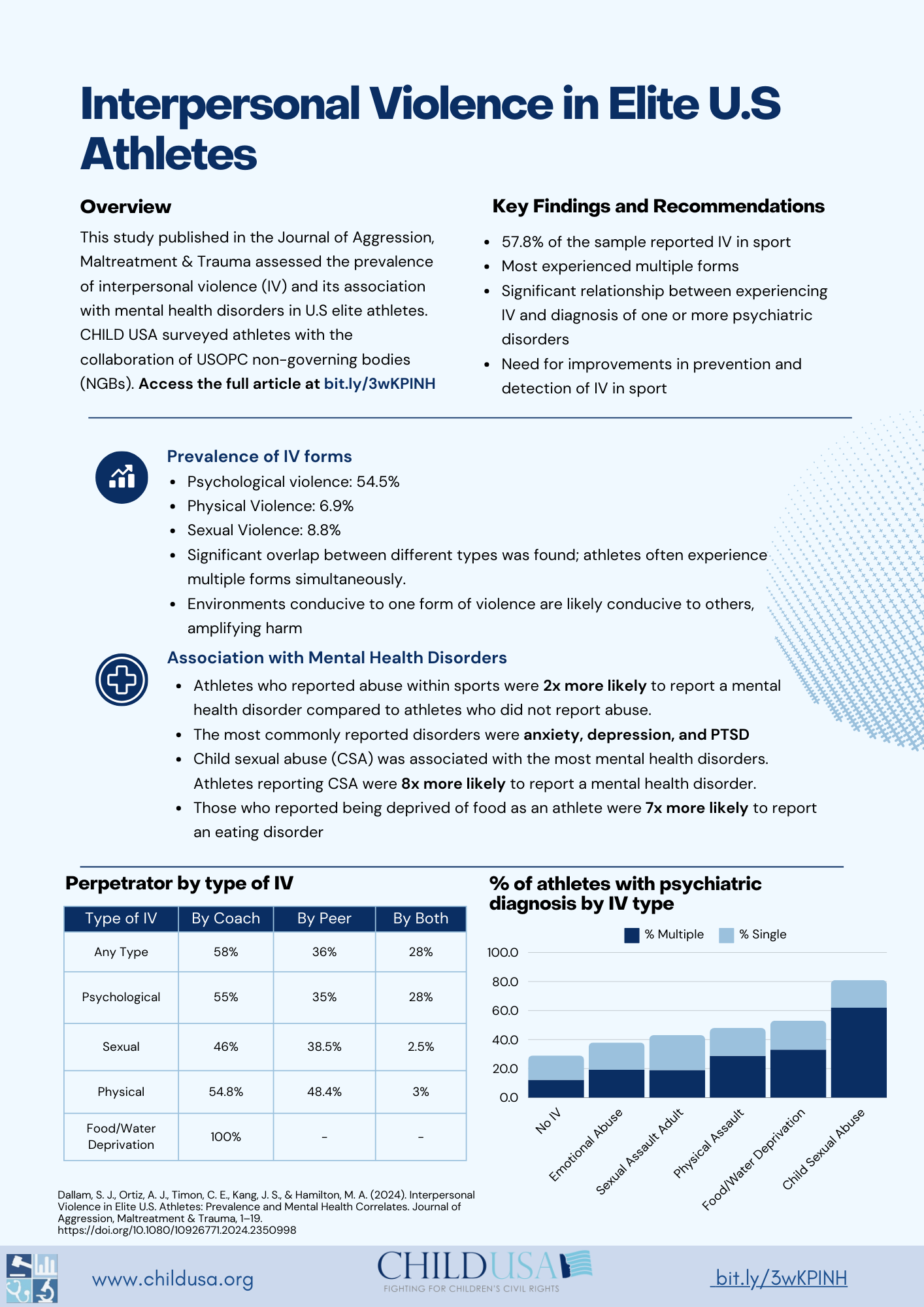
“Interpersonal Violence in Elite U.S. Athletes: Prevalence and Mental Health Correlates”
Download this One-Pager as a resource that summarizes the five key takeaways.
CHILD USA is proud to announce our groundbreaking study on interpersonal violence (IV) among elite U.S. athletes, the first comprehensive study of its kind. Published in the Journal of Aggression, Maltreatment & Trauma, this peer-reviewed research reveals alarming rates of psychological, physical, and sexual violence, as well as significant associations between abuse and mental health challenges.
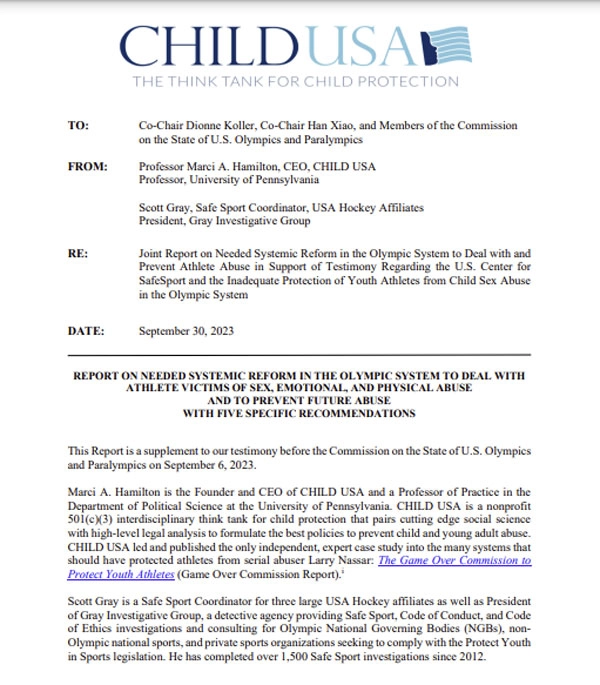
Report on Needed Systemic Reform in the Olympic System to Deal with and Prevent Athlete Abuse in Support of Testimony Regarding the U.S. Center for SafeSport and the Inadequate Protection of Youth Athletes from Child Sex Abuse in the Olympic System with Five Specific Recommendations
The existing Olympic system addressing the abuse of athletes requires adjustments to be more effective in reaching its goals. Athletes suffer from sex abuse, emotional abuse, and physical abuse. This Report outlines proposed systemic reform, which addresses all three forms of abuse and creates a more transparent and accountable system that will aid in greater protection of athletes through a fair process and in a trauma-informed way. Overall, we recommend a more athlete-centered system that speeds investigation times, decisions, and accountability, inserts a fair process for the athletes, and is transparent to the public.
The Impact of Restrictive Abortion Policies on Children: How Dobbs v. Jackson Women’s Health Organization Decision Negatively Affects Youth
Restrictions on abortions across the United States are creating negative health, educational, and economic consequences for children. These restrictions are causing irrevocable harm to pregnant children and will harm society as a whole.
What is delayed disclosure?
Disclosure refers to when a victim of child sexual abuse (CSA) tells someone about the abuse they endured, whether a peer, to a parent, another adult, or the authorities. Not all victims disclose, but for the CSA victims who do disclose, the vast majority need decades to come forward.
CHILD USA analyzed data on disclosure to explain why this “complex, lifelong process” can take decades or may never occur.
Family members, lawmakers, and investigators need to understand the facts about disclosure so they can support victims who come forward and help them seek justice. The public also needs this information to protect kids and prevent child sex abuse.
By the time most victims are able to come forward, the arbitrary deadlines for pressing charges or suing perpetrators and responsible institutions—known as statutes of limitation (SOL)—have expired. These short SOLs silence victims, assist perpetrators, and aid in institutional cover-ups.

A Realistic Estimate of the Impact of SOL Reform in Pennsylvania
The Susquehanna Valley Center for Public Policy estimates between 10,000 to 100,000 claims would be filed against public schools under a SOL revival window in PA.
In reality, claims would likely total less than 1,000, or one tenth of their lower estimate. An appropriate estimate range would be between 300 to 900 claims.
Survey of the Written Child Protection Policies of the 32 U.S. Archdioceses
Stephanie Dallam, Marci Hamilton, and Sabine Glocker ~ Accepted May 2021
ABSTRACT
Amid considerable public scrutiny, Roman Catholic institutions in the United States have been called upon to address underlying organizational conditions that may facilitate child sex abuse and establish effective policies for early intervention and prevention. The development of child protection policies has largely been left to the discretion of local dioceses with little in the way of central oversight. This study examined the 32 U.S. archdioceses’ written policies on child protection and maintaining a safe environment. We found 14 distinct policies spread across the archdioceses which fit into four general categories or domains: (1) Prevention of Child Sexual Abuse; (2) Detection and Reporting of Abuse; (3) Response to Victims; and (4) Investigational Process and Response to Allegations of Abuse. Using a tool developed from a list of unique components selected from the better policies of all 32 archdioceses, we compared policies across archdioceses. On a group level, we found current policies to be inadequate. The average score for all 32 archdioceses was 100.9 out of 250 possible points or 40%. The range was 61 to 137 (SD 20.4). The variation and inconsistencies across multiple archdioceses within the U.S. reveal the need for the Catholic Church to establish evidence-based standards on appropriately and effectively addressing child sexual abuse within its dioceses. These standards should be based on empirically supported best practices and emerging consensus of experts on better practices for youth-serving organizations in relation to child abuse. This article points to parameters for consideration in developing such standards.

WATCH School Survey Results
By: Carter E. Timon, MBDS, Lead Social Scientist
Elizabeth Allen, MS

Analysis of Victims of Abuse in Scouting, Part I
By: Marci A. Hamilton, Esq., CEO
Carter E. Timon, MBDS, Lead Social Scientist

Survey and Analysis of the Written Child Protection Policies of the 32 U.S. Roman Catholic Archdioceses
By: Marci A. Hamilton, Esq, CEO
Stephanie Dallam, Ph.D., lead investigator
Sabine Glocker, Esq.

COMPARISON OF THE WRITTEN CHILD PROTECTION POLICIES OF THE ARCHDIOCESE OF SAINT PAUL & MINNEAPOLIS TO THOSE OF OTHER U.S. ARCHDIOCESES WITH RECOMMENDATIONS FOR IMPROVEMENT
By: Marci A. Hamilton, Esq, CEO
Stephanie Dallam, Ph.D., principal investigator
Sabine Glocker, Esq., co-investigator

Roman Catholic Dioceses in Bankruptcy: An Exploratory Study of Victims’ Experiences
Since 2002, victims of child sexual abuse (CSA) have been afforded significantly more opportunities to bring claims against abusers and responsible institutions in civil litigation. This has often been facilitated by permitting victims whose claims had expired to revive these claims. Victims of abuse in the Roman Catholic Church context have initiated many claims in recent years, and Catholic dioceses have assiduously explored avenues to mitigate the costs of providing compensation to victims and to avoid further disclosures.