
Current Laws
For Child Protection
CHILD USA’s Legal Team
Warren Binford, JD, EDM
Chief Legal Officer

CHILD USA tracks laws that put children at risk so that we can study and improve those laws to prevent abuse and neglect.
CLICK HERE: Child Sex Abuse Statutes of Limitation Treatise (2002-2026)
A treatise outlining everything you need to start your statutes of limitation legal research.
2026 SOL REFORM BILLS
NEW SOL REFORM LAWS OR RESOLUTIONS GOING INTO EFFECT
| State | SOL Reform Law | |
| Arkansas | Opens a 1-year revival window for child sexual abuse claims against an entity that has been provided protection under a plan of reorganization initiated by a congressionally chartered organization on February 18, 2020 (Boy Scouts of America bankruptcy). (S.B. 13 (Act 49)) (Enacted 2025; effective date not confirmed in tracker) | |
| Eliminates the criminal SOL for certain human trafficking-related offenses, including sexual extortion involving minors, trafficking of persons, patronizing a victim of human trafficking, and grooming a minor. Also creates safe harbors for victims and prohibits certain sexually explicit products that resemble a child. (S.B. 431 (Act 987)) (Effective April 23, 2025) | ||
| California | Extends the period for reviving sexual assault claims barred by the SOL through January 1, 2026, and allows civil filings until December 31, 2027, while exempting public entities and requiring allegations of cover-ups by responsible entities. (A.B. 250) (Effective Jan. 1, 2026) | |
| Illinois | Eliminates the criminal SOL for trafficking offenses against minors (involuntary servitude, involuntary sexual servitude of a minor, and trafficking in persons), allowing prosecution at any time for offenses occurring on or after the effective date. (H.B. 2602 (Public Act 104-0241)) (Effective Jan. 1, 2026) | |
| Renames “child pornography” to “child sexual abuse material” throughout Illinois law and extends the criminal SOL for grooming, allowing prosecution within 10 years after the victim attains 17 years of age. (H.B. 2690 (Public Act 104-0245)) (Effective Jan. 1, 2026) | ||
| Maryland | Allows child sexual abuse claims to be filed at any time but prohibits such claims against the State after January 1, 2026, and caps noneconomic damages. CHILD USA opposes the State liability restriction and damages cap, which roll back protections from the 2023 Maryland Child Victim’s Act. (H.B. 1378 (Chapter 104)) (Effective June 1, 2025) | |
| Missouri |
H.B.737/486 + S.B.43 + S.B.81/174 – These three bill numbers merged into a single amendment to the civil childhood sexual abuse statute (§537.046). It revises the definition of “childhood sexual abuse” for civil damages claims, makes nondisclosure agreements in CSA cases void and unenforceable, and applies to actions on or after August 28, 2025, including some that were previously time-barred. Important: the separate SOL age-cap extension (S.B.589) did NOT pass, so please don’t describe this as Missouri extending its SOL.
Status/effective: Enacted; effective August 28, 2025.
Sources: revisor.mo.gov/main/OneSection.aspx?section=537.046 | mocadsv.org/legislative_updates/2025-end-of-session-report/
|
|
| Oklahoma | Extends the criminal SOL for sexual crimes against children, including rape and lewd acts, to age 45. Prosecution may be commenced at any time with DNA evidence. (H.B. 1935) (Effective Nov. 1, 2025) | |
| Oregon | Eliminates the civil SOL for both child sexual abuse and adult sexual assault, allowing claims to be filed at any time for incidents occurring on or after the effective date. (H.B. 3582) (Effective June 26, 2025) | |
| Tennessee | Extends the civil SOL for child sexual abuse from 15 to 30 years from the victim’s 18th birthday. Also extends from 25 to 30 years the threshold beyond which prosecutors must offer corroborative evidence for late criminal prosecutions. (H.B. 0973 (Public Chapter 291)) (Effective July 1, 2025) | |
| Texas | Eliminates the criminal SOL for failure to stop or report sexual or assaultive offenses against a child, and creates the crime of continuous promotion of prostitution with no SOL. (H.B. 1778) (Effective Sept. 1, 2025) | |
| Limits the civil liability of nonprofit entities contracted with the Department of Family and Protective Services or with a single source continuum contractor providing community-based care or child welfare services. CHILD USA opposes. (S.B. 1558) (Effective Sept. 1, 2025) | ||
| Adds continuous sexual abuse of a young child and indecency with a child to the criminal no-limitation list. Also extends the criminal SOL for fraud offenses to 7 years and clarifies that the 20-year-from-18-birthday SOL applies to trafficking of a child. (S.B. 2798) (Effective Sept. 1, 2025) | ||
| Total | Eight States with New SOL Reform Laws in 2025 | |
| 2026 New SOL Reform Laws | ||
| Idaho |
H.681 Expands the list of felonies with no criminal statute of limitations to add aggravated lewd conduct with a minor under 16 (§18-1508B), aggravated lewd conduct with a minor 12 or under (§18-1508C), and the production of child sexual abuse material (§18-1507(2)(b)). Note: this does NOT create the no-SOL rule for child sexual abuse — Idaho already eliminated that; H.681 expands the list.
Status/effective: Enacted; Session Law Chapter 191; effective July 1, 2026.
Sources: legislature.idaho.gov/wp-content/uploads/sessioninfo/2026/legislation/H0681.pdf | legiscan.com/ID/bill/H0681/2026
|
|
| Utah |
S.B.30 (Human Trafficking, Exploitation, and Smuggling Amendments) Adds the newly created child sex-trafficking offense (human trafficking of a child for commercial sexual exploitation, §76-5-308.6) and aggravated human trafficking for commercial sexual exploitation (§76-5-310.2) to the list of crimes prosecutable at any time (no criminal SOL, §76-1-301). No offense loses no-SOL status.
Status/effective: Enacted; signed March 23, 2026; effective May 6, 2026.
Sources: le.utah.gov/Session/2026/bills/enrolled/SB0030.pdf (Section 7) | le.utah.gov/Session/2026/bills/static/SB0030.html
|
|
|
H.B.139 (Female Genital Mutilation Amendments) Eliminates the criminal statute of limitations for female genital mutilation by adding the offense (§76-5-702) to the no-criminal-SOL list (§76-1-301); also repeals the FGM community-education-program requirement.
Status/effective: Enacted; effective May 6, 2026.
Sources: le.utah.gov/Session/2026/bills/enrolled/HB0139.pdf | trackbill.com/bill/utah-house-bill-139-female-genital-mutilation-amendments/2762605/
|
|
|
| Total |
Three States with New SOL Reform Laws in 2026
|
|
SOL REFORM BILLS PASSED IN LEGISLATURE
| State | Bill | Description | Bill Link |
| California | S.B.577 | State Government. (CHILD USA opposes) | View Bill |
| Delaware | H.B. 75 | An Act To Amend Title 10 Of The Delaware Code Relating To The Statute Of Limitations For Civil Claims Based On Sexual Abuse Of A Minor. | View Bill |
| Maine | ME L.D. 1427 (H.P. 936) (Effective July 14) | An Act Extending the Statute of Limitations on Criminal Actions Involving Aggravated Sex Trafficking. 20 year SOL for aggravate sex trafficking. | View Bill |
| Michigan | S.B.0258 | Civil procedure: statute of limitations; civil actions for criminal sexual conduct; modify period of limitations. Amends sec. 5805 of 1961 PA 236 (MCL 600.5805). TIE BAR WITH: SB 259’25, SB 257’25 | View Bill |
| Missouri | H.B. 68 | Modifies the statute of limitations for personal injury claims from five years to two years | View Bill |
| New Jersey | A.5004 | Creates separate crime for items depicting sexual exploitation or abuse of children; concerns computer generated or manipulated sexually explicit images. | View Bill |
| New Mexico | H.B. 73 | Childhood Sexual Abuse Statute Of Limitations | View Bill |
| New York | S.116 | Relates to the statute of limitations of actions related to certain sex trafficking offenses | View Bill |
| Texas | H.B. 380 | Relating to certain statutes of limitations for criminal offenses, including the statute of limitations for the offense of improper relationship between educator and student, and to the applicability of sex offender registration requirements for the offense of improper relationship between educator and student. | View Bill |
| Utah | H.B.117 | Sexual Abuse Statutes of Limitation Amendments | View Bill |
| Washington | S.B. 5105 | SB 5105 (Effective June 11, 2026) updates the state’s child protection laws to cover AI-generated and digitally fabricated sexual images of minors, even when no real child exists, and strengthens penalties accordingly. Effective June 11, 2026, it also extends the statute of limitations for these crimes to ten years, closing critical gaps in the digital age. | View Bill |
SOL REFORM BILLS INTRODUCED IN LEGISLATURE
| State | Bill | Description | Bill Link |
| Hawaii | H.B.384 | RELATING TO SEXUAL OFFENSES AGAINST MINORS. | View Bill |
| Illinois | HB1114 | Limitations-Victim Under 18 | View Bill |
| Indiana | S.B.0143 (2026) |
Would eliminate the criminal SOL for Level 3 felony rape (IC 35-42-4-1) and Level 3 felony child molesting (IC 35-42-4-3) — making them prosecutable at any time — and adds a clause reviving previously time-barred cases. Amends IC 35-41-4-2.
Status: Introduced; pending in Senate Corrections & Criminal Law Committee.
|
View Bill |
| S.B.0196 (2025) |
The prior-session predecessor of S.B.0143 — same IC 35-41-4-2 amendment (no criminal SOL for Level 3 rape and child molesting). Died in committee in the 2025 session. List as the 2025 version of the same reform.
|
View Bill | |
| Iowa | H.F.908 | A bill for an act relating to human trafficking, including screening children, civil statutes of limitations, an annual stakeholder meeting and report, depositions of victims, restitution, restorative facilities and protective services, and investigation and prosecution, and making appropriations.(Formerly HF 452; See HF 1036.) | View Bill |
| S.F.364 | A bill for an act modifying the periods of time to bring certain civil actions by victims of sexual abuse and other sexual offenses that occurred when the victim was a minor, entitling certain cases to a preference in trial order, and including effective date provisions. | View Bill | |
| S.F.67 | A bill for an act modifying the periods of time to bring certain civil actions, including by victims of sexual abuse, minors, and persons with mental illness, entitling certain cases to a preference in trial order, and including effective date provisions. | View Bill | |
| Kentucky | H.B.232 | AN ACT relating to childhood sexual assault or abuse. | View Bill |
| Massachusetts |
H1732 | An Act amending the statute of limitations relating to civil rights actions and criminal prosecutions for the sexual assault and rape of a child | View Bill |
| H1829 | An Act eliminating the statute of limitation in civil child sexual abuse cases | View Bill | |
| S404 | An Act relative to supporting survivors of child sexual abuse | View Bill | |
| MA H5630 (Introduced July 30) | An Act strengthening primary care and advancing health care affordability. | View Bill | |
| Mississippi | S.B. 2318 | Child sexual abuse; revise statute of limitations for claims. | View Bill |
| Missouri | H.J.R. 58 | Proposes a constitutional amendment allowing ex post facto laws to be enacted if the laws involve civil child sexual abuse claims | View Bill |
| S.B. 589 | Modifies provisions relating to civil actions for childhood sexual abuse, including the statute of limitations for such actions | View Bill | |
| S.B. 747 | Modifies provisions relating to civil actions for childhood sexual abuse, including the statute of limitations for such actions | View Bill | |
| New York | A.1641 | Removes statute of limitations for certain civil actions related to child sexual assault offenses | View Bill |
| A.2575 | Relates to the statute of limitations of actions related to certain sex trafficking offenses | View Bill | |
| A.7003A | Expands the statute of limitations for certain sex offenses | View Bill | |
| A.7258 | Enacts the Child Sexual Abuse Reform Act; provides for the elimination and extension of certain statutes of limitations relating thereto | View Bill | |
| S.6978 | Removes statute of limitations for certain civil actions related to child sexual assault offenses | View Bill | |
| Oregon | H.B.3581 | Removes the statute of limitations for most felony sex crimes. | View Bill |
| Rhode Island | H.B.6133 | An Act Relating To Criminal Procedure — Indictments, Informations And Complaints (Provides That The Statute Of Limitations For Second-Degree Sexual Assault Shall Be 10 Years From The Date Of The Offense, Or, In The Case Of A Victim Who Is Under The Age Of 18, Ten Years From The Victim’S Eighteenth Birthday, Whichever Is Later.) | View Bill |
| S.B.739 | An Act Relating To Courts And Civil Procedure–Procedure Generally — Causes Of Action (Makes All Causes Of Action Based On Sexual Abuse Or Exploitation Of A Child Not Subject To Any Statute Of Limitations Whether The Claim Has Lapsed Or Was Previously Time-Barred.) | View Bill | |
| South Carolina | S.B.0148 | Sexual Abuse and Incest | View Bill |
| Tennessee | SB1070 | Statutes of Limitations and Repose – As enacted, extends the statute of limitations for criminal prosecution of certain child sexual abuse felonies from 25 years from the child’s eighteenth birthday to 30 years from the child’s eighteenth birthday; extends the statute of limitations for a civil action based on child sexual abuse from 15 years from the child’s eighteenth birthday to 30 years from the child’s eighteenth birthday. – Amends TCA Title 28 and Title 40, Chapter 2. Companion bill has been assigned Public Chapter 291 by the Secretary of State. Conference Committee Reports | View Bill |
| SB1234 | Civil Procedure – As introduced, revives causes of action based on a sexual assault that occurred when the injured party was 18 years of age or older and are time-barred because the applicable statute of limitations has expired; allows such actions to be commenced within a certain time period. – Amends TCA Title 28, Chapter 3; Title 39 and Title 40. Conference Committee Reports | View Bill | |
| Texas | H.B. 2022 | Relating to elimination of limitations periods for suits for personal injury arising from certain offenses against a child or disabled individual. | View Bill |
| H.B. 3453 | Relating to the liability of nonprofit entities contracted with the Department of Family and Protective Services or with a single source continuum contractor to provide community-based care or child welfare services. (CHILD USA opposes) | View Bill | |
| H.B. 4724 | Relating to the civil liability of nonprofit entities. (CHILD USA opposes) | View Bill | |
| H.J.R. 120 | Proposing a constitutional amendment protecting children by allowing for retroactive laws regarding civil causes of action arising out of child sexual abuse. | View Bill | |
| S.B. 1167 | Relating to elimination of limitations periods for suits for personal injury arising from certain offenses against a child or disabled individual. | View Bill | |
| S.J.R. 51 | Proposing a constitutional amendment protecting children by allowing for retroactive laws regarding civil causes of action arising out of child sexual abuse. | View Bill |
CHILD USA’s Legal Reports
CHILD SEX ABUSE STATUTES OF LIMITATION TREATISE (2002 TO 2026)
A resource book outlining everything you need to start your statutes of limitation legal research for every U.S. jurisdiction, including federal, state, and U.S. territories.
CHILD USA has diligently tracked SOL Reform in all 50 states for years! Our Legal team has compiled your go-to resource book to get started on your SOL legal research. Topics include:
Civil CSA SOLs since 2002
Criminal CSA SOLs since 2002
Tolling theories
Discovery rules
Trafficking
CSAM
Rankings
Revival laws
State-by-state comparisons
and more!
LEGAL & REGULATORY FRAMEWORKS FOR ADDRESSING AI-GENERATED CSAM IN THE U.S. & CANADA
This report offers a comprehensive doctrinal analysis of U.S. and Canadian laws related to the creation, possession, and distribution of AI-generated child sexual abuse material (CSAM). It evaluates both criminal and civil liability frameworks, as well as regulatory responsibilities of developers, dataset holders, and online service providers. The report also explores current legislative proposals on AI governance, identifying legal gaps and proposing reforms to better safeguard children against new forms of digital exploitation.
The findings from this report were used to contextualize and inform the broader comparative analysis across Five Eyes nations as part of a study included in the Childlight Global Child Safety Institute’s Searchlight 2025 Report: Who Benefits? Shining a Light on the Business of Child Sexual Exploitation and Abuse.
Specifically, it informed Study F – Legal Challenges in Tackling AI-Generated Child Sexual Abuse Material Across the UK, USA, Canada, Australia, and New Zealand: Who Is Accountable Under the Law?
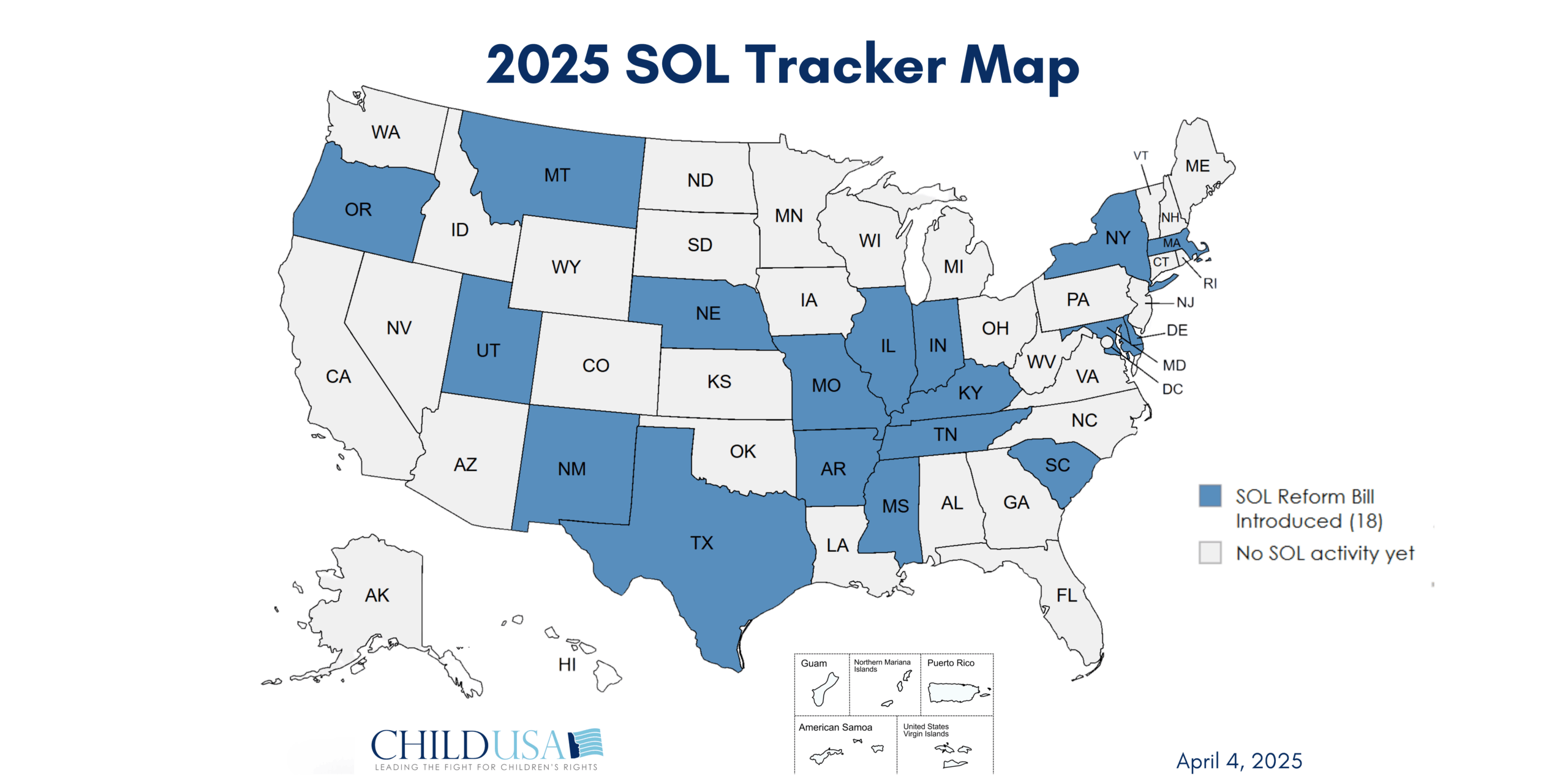
With the CSA SOL Treatise and our weekly updated SOL Tracker, we have what you need in your cases to start your statutes of limitation legal research for every U.S. jurisdiction, including federal, state, and U.S. territories.
CHILD USA leads the national SOL reform movement and tracks every SOL reform bill for child sex abuse introduced in state legislatures across the country. Our SOL Tracker provides an overview of all pending bills and new laws and is updated on a weekly basis. It also highlights states that have eliminated SOLs and revived expired claims.
2024 Report National Overview on the State of Children’s Rights to Education in America
At CHILD USA, we believe every child deserves a quality education that leads to a brighter future. Our new report, “National Overview on the State of Children’s Rights to Education in America,” uncovers significant gaps in educational oversight, particularly for children in homeschooling and private school environments.
With 33% of states not recognizing “educational neglect” in their laws, millions of children are at risk of being left behind. Our report provides a comprehensive look at K-12 education across the U.S. and ranks states based on their children’s educational rights protections.
This report is intended to be used as a reference for lawmakers, advocates, researchers, educators, and the public to better understand the existing laws, identify gaps and disparities therein, and develop strategies to protect and enhance children’s educational rights, including but not limited to, adoption of CHILD USA’s policy recommendations.
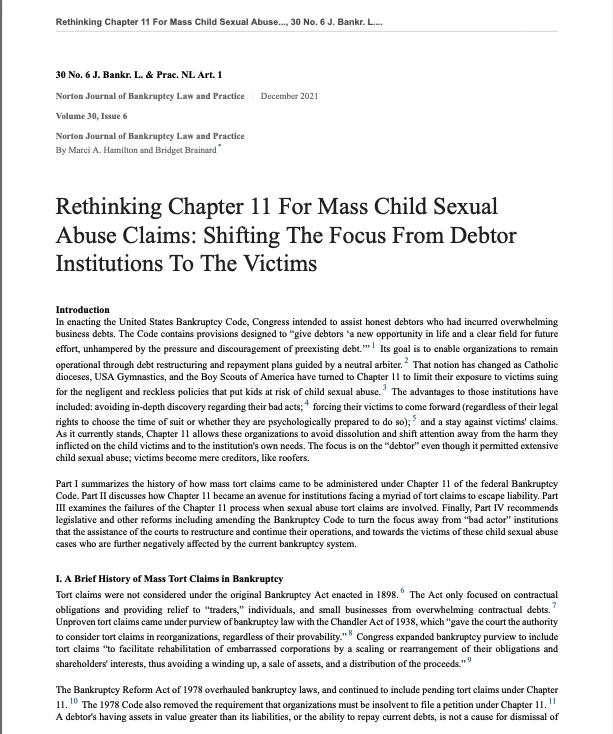
RETHINKING CHAPTER 11 FOR MASS CHILD SEXUAL ABUSE CLAIMS: SHIFTING THE FOCUS FROM DEBTOR INSTITUTIONS TO THE VICTIMS
There is no one quick fix to make Chapter 11 a proceeding that is a safe space for victims and a process to educate the public on the prevalence and long-lasting effects of child sexual abuse. Bankruptcy law was designed to provide an honest debtor reprieve from debilitating debt, and Chapter 11 to enable an organization to remain operational until it can restructure its debts through a reorganization plan.
Instead, Chapter 11 has been used as an avenue for institutions facing mass tort claims to avoid being financially crushed from the outcomes of those claims while also evading their responsibility for the lifelong harms caused to their victims. Specifically, youth-serving organizations that are alleged and proven to have played a role in child sexual abuse cases continue to seek refuge in the bankruptcy system, creating significant problems for the victims seeking, not just financial compensation, but answers related to the failures of the institutions to protect them.
Legislative reform to Chapter 11 is required to shift the role of bankruptcy law from merely assisting the responsible organizations in improving their financial state and escaping liability, to ensuring that these institutions are held accountable and victims of child sexual abuse secure fair outcomes.
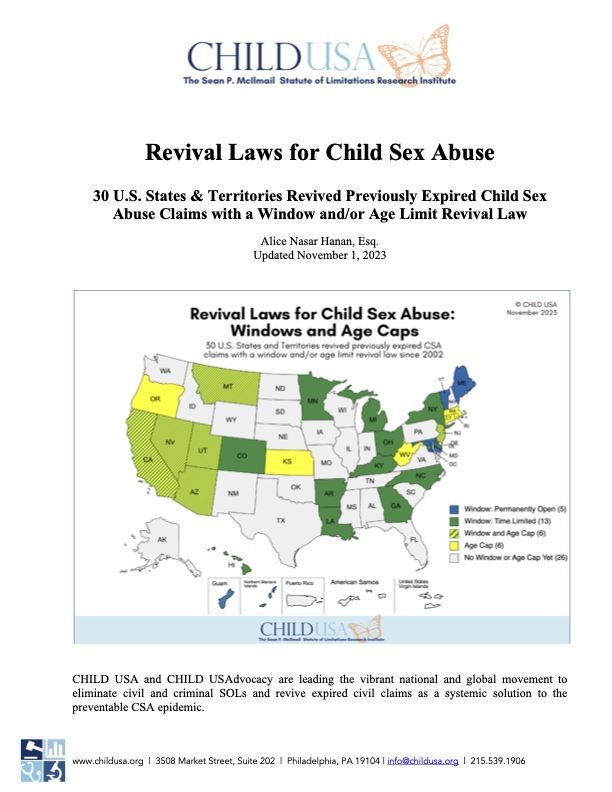
A REPORT ON U.S. REVIVAL WINDOWS AND AGE LIMIT REVIVAL LAWS
An overview of all window and age limit revival laws for child sex abuse in the United States, which includes laws in 33 U.S. Jurisdictions, including 30 States and 3 Territories. Revival windows are now open in Arkansas, Louisiana, Maine, Maryland, Nevada, New York City, Vermont, Northern Mariana Islands, and Guam. Limited windows are also open in Ohio, Indiana, Alabama, and Iowa only for Boy Scout survivors. Several states have revived claims until a survivor reaches a certain age, ranging from 27-55 years old.
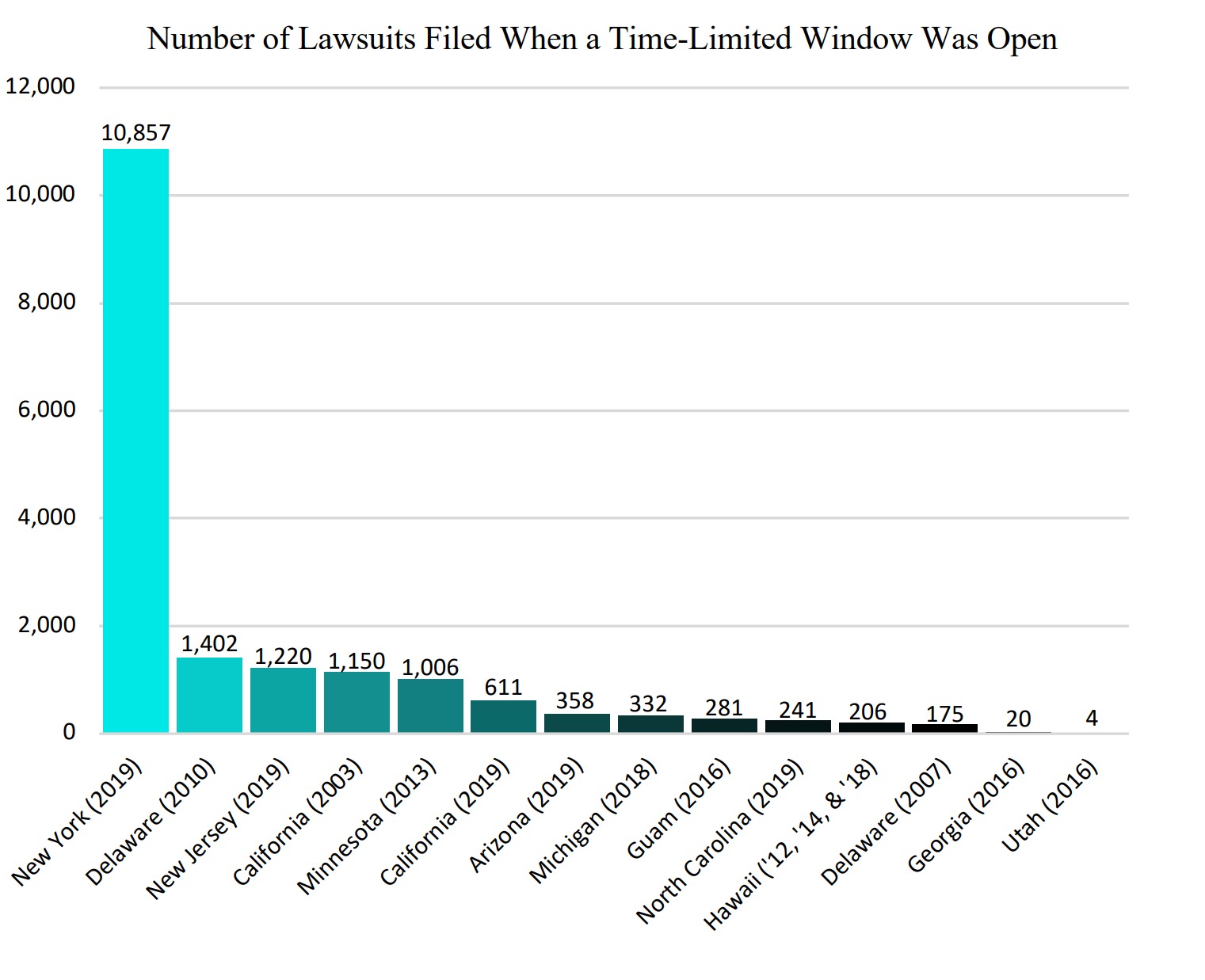
The Relative Success of State Windows for Child Sexual Abuse Claims
Read about the relative success of state windows for child sexual abuse claims here.
The Relative Success Memo documents the success of state revival windows for child sexual abuse claims both in the total number of lawsuits filed under each window and the public identification of previously unknown predators and enabling institutions.
A NATIONAL OVERVIEW OF CHILD MARRIAGE DATA AND LAW – a comprehensive report on child marriage in the United States.
The current worldwide total number of child marriage is about 755 million, and while many people cling to the flawed assumption that child marriage is not an American issue although, almost 300,000 children were married in the US alone between 2000 and 2018. Thus, they are at higher risk for harms including death, serious health issues, and physical and sexual violence.
- Mandatory age floors set at 18
- Proof of age and residency requirements (currently, only 22 states strictly require official proof of age)
- The elimination of parental and judicial consent exceptions.
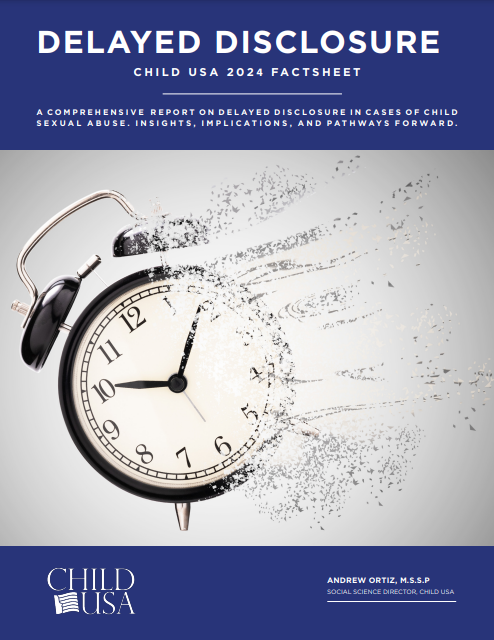
DELAYED DISCLOSURE OF CHILD SEX ABUSE FACTSHEET
WHAT IS DELAYED DISCLOSURE?
Disclosure refers to when a victim of child sexual abuse (CSA) tells someone about the abuse they endured, whether a peer, to a parent, another adult, or the authorities. Not all victims disclose, but for the CSA victims who do disclose, the vast majority need decades to come forward.
CHILD USA analyzed data on disclosure to explain why this “complex, lifelong process” can take decades or may never occur.
Family members, lawmakers, and investigators need to understand the facts about disclosure so they can support victims who come forward and help them seek justice. The public also needs this information to protect kids and prevent child sex abuse.
By the time most victims are able to come forward, the arbitrary deadlines for pressing charges or suing perpetrators and responsible institutions—known as statutes of limitation (SOL)—have expired. These short SOLs silence victims, assist perpetrators, and aid in institutional cover-ups.
REPORT ON ENFORCING THE RIGHTS OF CHILDREN IN MIGRATION
A Preliminary Report on the New York Child Victims Act
Read more about the New York Child Victims Act and why statute of limitations reform serves the public interest, here.
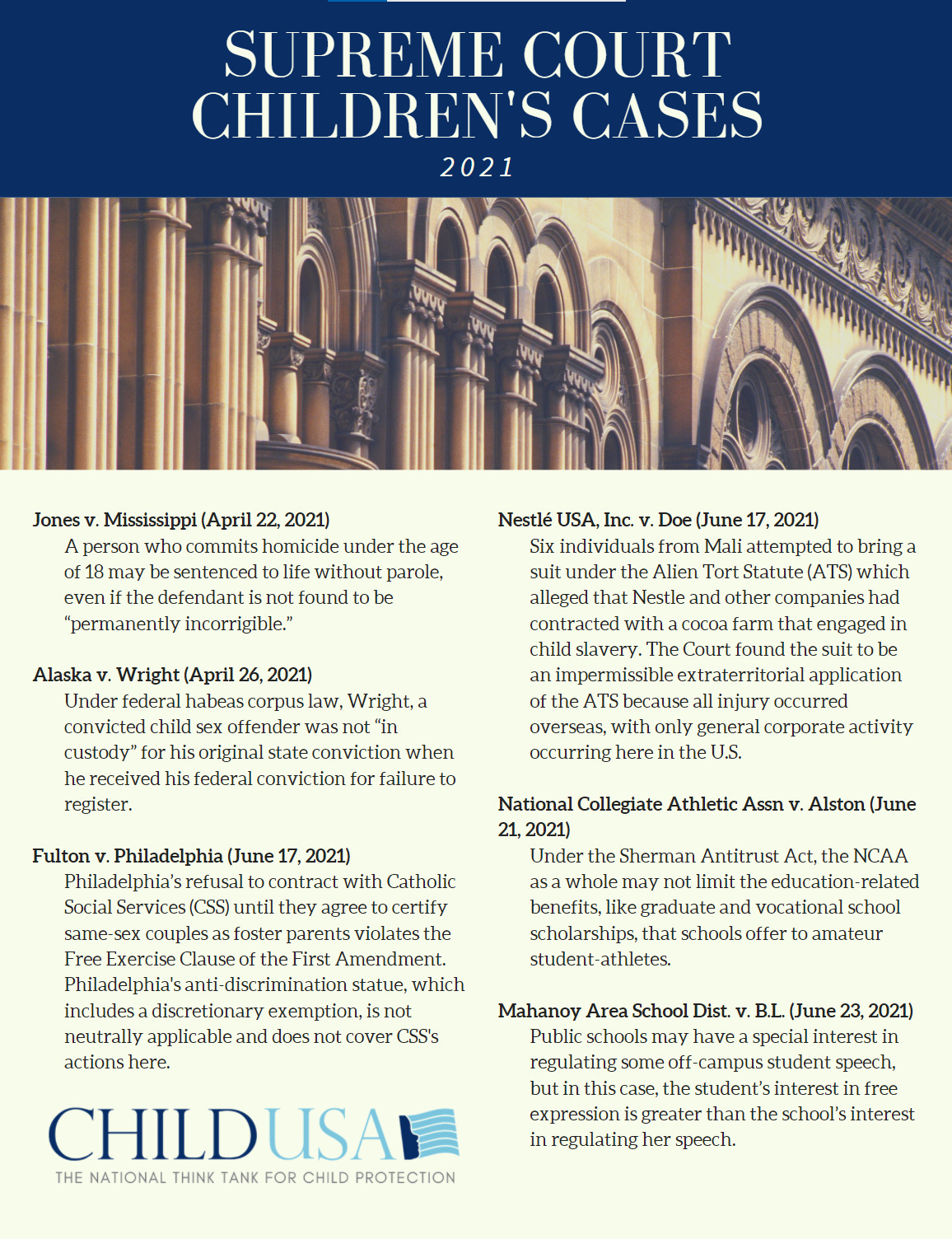
2021 Supreme Court Cases Relevant to Children
Read more about the cases reviewed by the United States Supreme Court this year, here.
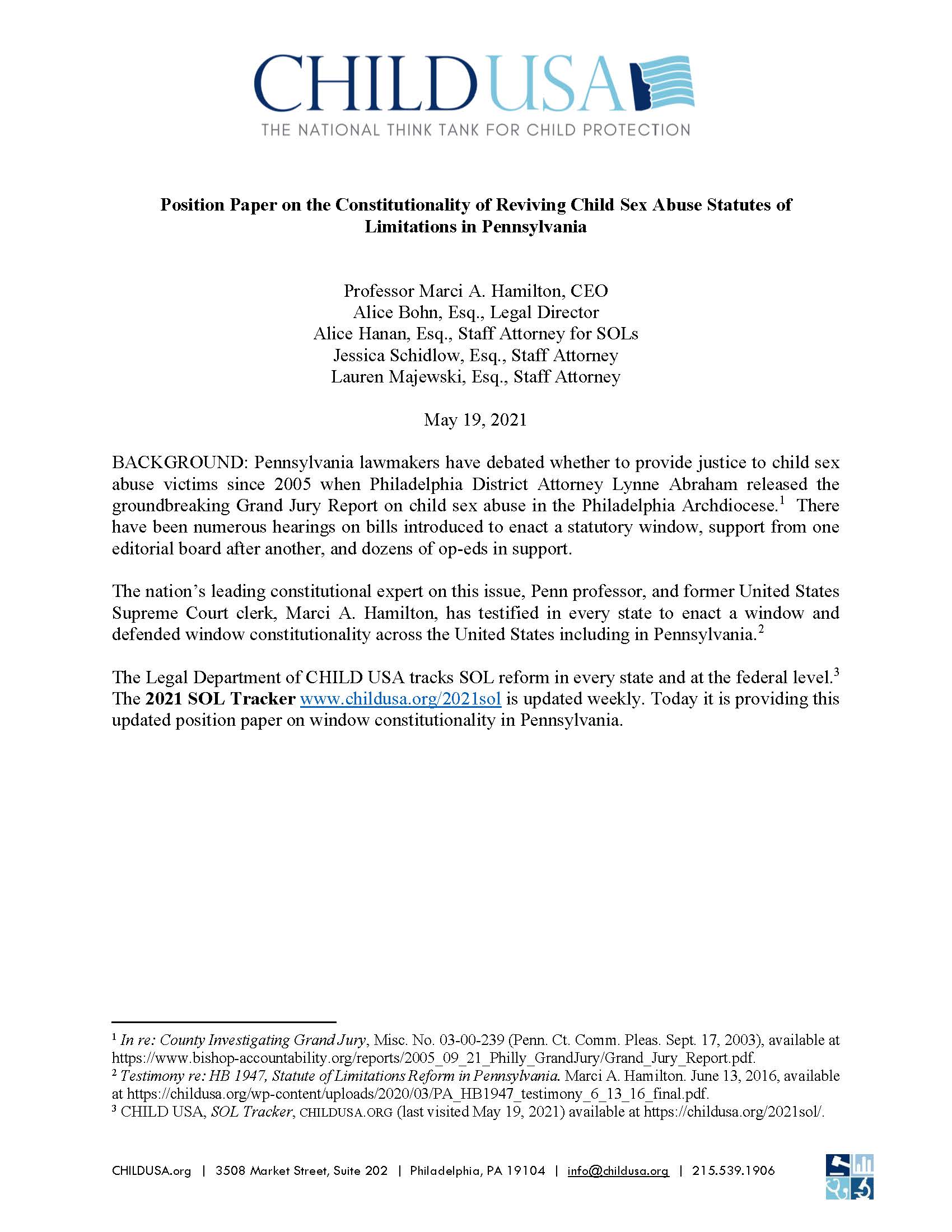
BACKGROUND: Pennsylvania lawmakers have debated whether to provide justice to child sex abuse victims since 2005 when Philadelphia District Attorney Lynne Abraham released the groundbreaking Grand Jury Report on child sex abuse in the Philadelphia Archdiocese. There have been numerous hearings on bills introduced to enact a statutory window, support from one editorial board after another, and dozens of op-eds in support.
The nation’s leading constitutional expert on this issue, Penn professor, and former United States Supreme Court clerk, Marci A. Hamilton, has testified in every state to enact a window and defended window constitutionality across the United States including in Pennsylvania.
Click here for an analysis of the constitutionality of revival windows.
Click here for an outline of Pennsylvania caselaw showing that a revival window is constitutional.
Click here to see why Pennsylvania needs a revival window.
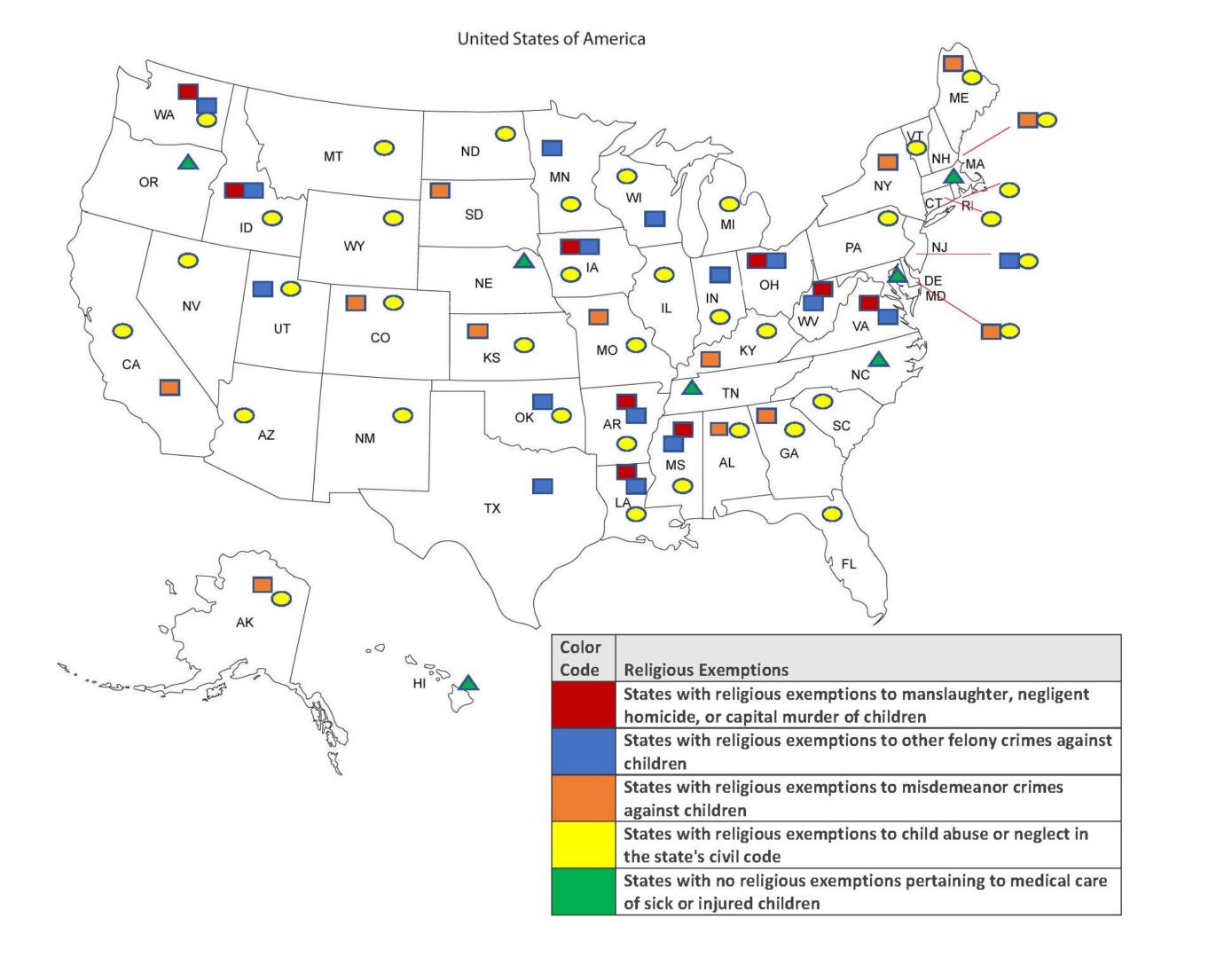
RELIGIOUS EXEMPTIONS TO MEDICAL CARE
An explanation of religious exemptions to medical care and why they need to be eliminated
We are investigating the states with inadequate protection laws against child sex abuse, maltreatment, physical abuse, and neglect.
The information regarding child protection laws provided is solely for informational purposes and is not legal advice. To determine the law in a particular sex abuse or maltreatment case, contact a lawyer in the state.